Information, not advice. Raja Ampat Investment Intelligence is an independent editorial guide. This page is general information, not financial, legal, tax, or investment advice, and we never promise returns. Indonesian regulations and customary (adat) land rights are complex and change — verify everything with licensed Indonesian counsel, a notaris, and customary-law experts before any decision. Where useful we can introduce you to vetted independent partners; we may receive a referral fee, at no cost to you.
Raja Ampat liveaboard business investment describes the acquisition, permitting, and operation of a live-aboard dive vessel — most commonly a traditional Indonesian phinisi — as a commercial enterprise in and around the Raja Ampat Marine Protected Area. Unlike land-based resorts, a liveaboard is a mobile asset: it can legally rotate between Raja Ampat, the Banda Sea, and Komodo across a single season, which changes the risk and revenue profile meaningfully compared with a fixed island lodge. Most operators structure ownership through an Indonesian PT PMA or a national PT, because the vessel must be registered under Indonesian maritime law and the operating permits are issued to a legal entity, not an individual.
What the land-listing pages ignore is that phinisi business in Raja Ampat is a genuinely separate asset class — and the economics of running one differ from every other category in this market. It sits outside the adat land question entirely — you are buying or building a vessel, not leasing clan-held coastline. That simplicity comes with its own complications: cabotage law, marine-park operating permits, Indonesian ship registration for foreign-owned operators, and the economics of running a floating hotel in one of the world’s most remote archipelagos. This guide maps what is verifiable. It does not tell you whether to invest.
The Phinisi as a Business Asset: What You Are Actually Buying
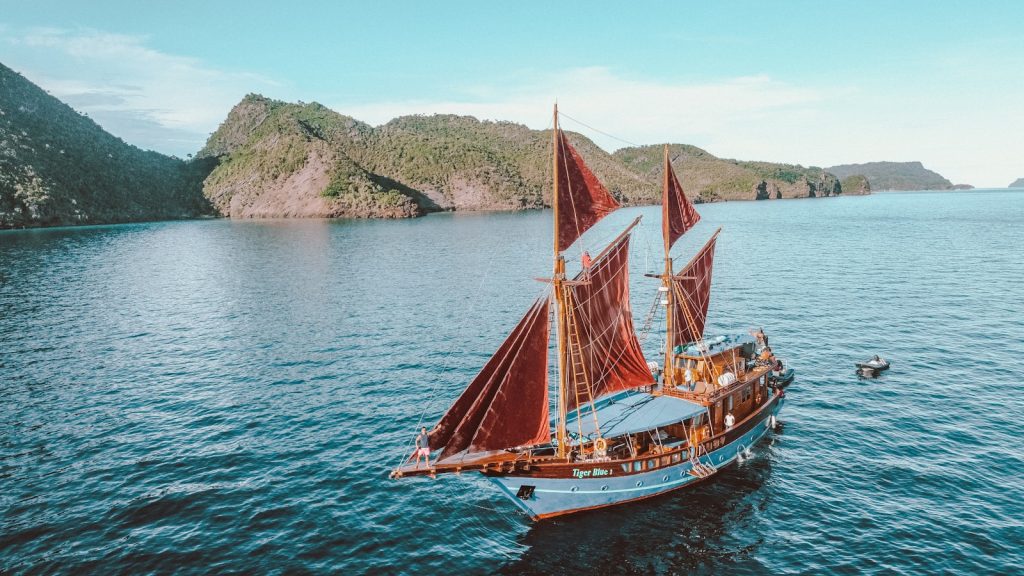
A phinisi is a traditional two-masted wooden sailing vessel originating from the Bugis shipbuilding tradition of South Sulawesi. For dive tourism purposes the modern phinisi is functionally a motor-sailer: diesel-powered with sails used occasionally or for atmosphere, designed around guest cabins (typically 6 to 16), a dive deck, camera rinse station, and compressor room. The vessel is the business. There is no land component — the boat anchors in open water or at mooring buoys, and guests board from a dinghy or tender.
Two entry paths exist for a phinisi business in Raja Ampat. You can commission a new build from Sulawesi or Kalimantan yards, or you can purchase an existing vessel, ideally one that already holds relevant permits. The distinction matters a great deal for timeline and capital planning.
Commissioning a New Phinisi Build
New phinisi are built predominantly in Bulukumba (South Sulawesi) and, to a lesser extent, in East Kalimantan yards. Construction time for a finished live-aboard specification vessel — cabins fitted, electrical systems installed, dive deck configured — typically runs 18 to 30 months depending on size and the detail of your specification. Vessels are framed in iron wood (ulin) or mixed hardwoods; quality varies significantly between yards and project management matters as much as the hull contract.
Published price ranges for phinisi construction are not reliable because the specification range is enormous. A stripped bare 25-meter hull is a very different project from a 40-meter, air-conditioned, 12-cabin dive vessel with a generator set, watermaker, and satellite communications package. Investors who have gone through the process consistently report that the gap between initial quote and finished cost is material — budget management, not just negotiation, determines final outlay. Material costs in Indonesia track global commodity prices and have risen sharply since 2022. Get independent quantity surveying and retain a site supervisor with prior phinisi experience.
Buying an Existing Liveaboard in Raja Ampat
The resale market for operational liveaboards in Indonesia is thin and largely relationship-driven. Those looking to buy a liveaboard in Raja Ampat find listings rarely sit on public platforms the way island leases do. Most transactions happen through operator networks, dive industry contacts, or — occasionally — through distressed sales when an operator exits after a difficult season or a partnership dispute. This illiquidity is a genuine risk at exit: the buyer pool for a permitted, operational phinisi is smaller than the buyer pool for a leasehold island.
The specific advantage of buying an existing vessel is the permits. A boat that already holds a valid SIUPAR (nautical tourism business license), a marine park operating permit from the Raja Ampat MPA authority, and a current Surat Ukur (measurement certificate) and Grosse Akta (vessel deed) under Indonesian maritime law is worth substantially more than the same hull without that paper trail. Verify each document independently — do not rely on the seller’s summary.
Maritime Permits and the Marine Park Operating Framework
Operating a commercial dive liveaboard inside the Raja Ampat Marine Protected Area network requires a layered set of permits. The MPA network covers approximately 13,550 km² of marine area and is managed by a provincial UPTD with BLUD (public service body) status — meaning it collects and retains its own environmental fees rather than remitting them centrally. That operational independence matters: the Marine Park Authority can and does enforce permit conditions independently of the national government.
National Maritime and Tourism Licensing
Tourism KBLI codes relevant to a liveaboard operation span multiple categories. Sea passenger and charter transport falls under approximately KBLI 50119; marine recreation and dive tourism under 93119 or 93299; tour operations under 79122. Getting the KBLI selection right before you apply matters — wrong codes mean the wrong downstream licenses, which creates compliance gaps that surface during inspections or insurance claims. This is a practical reason to use a licensed business-setup consultant with specific maritime tourism experience, not a generic PT PMA incorporation service.
Raja Ampat MPA Operating Permits
Beyond national licensing, liveaboard operators in Raja Ampat require an operating permit from the Marine Park Authority (KKP UPTD BLUD). This permit covers the right to conduct commercial dives inside the MPA zone, access specific sites, and bring paying guests. The authority monitors compliance with site rotation protocols and environmental conditions.
Separately, every foreign visitor aboard the vessel must hold a valid Marine Park entry tag — currently IDR 700,000 per foreign visitor and IDR 425,000 per domestic visitor, valid for 12 months and multiple entries. On a 14-day liveaboard with 16 guests, the pass cost alone is a material line item in the guest’s package price. Operators typically include this in quoted rates; some guests arrive with existing valid tags. The revenue flows directly to the BLUD, not to the operator.
Shark and Manta Sanctuary Compliance
Raja Ampat holds Indonesia’s first shark and ray sanctuary designation. This covers all shark and ray species — reef sharks, wobbegongs, the endemic walking sharks, oceanic manta rays (Mobula birostris), and reef manta rays (Mobula alfredi). The prohibition covers catching, injuring, killing, possessing, trading, or transporting listed species or their parts. For a liveaboard operator, this means no shark feeding, no fishing for sharks, and active guest briefing obligations — a compliance cost in training and operational protocol, not just a legal requirement. The sanctuary is also a marketing asset: guests come specifically to encounter these animals in protected conditions.
Mooring, Anchoring, and the No-Drop-on-Coral Rule
Anchoring directly on live coral is prohibited throughout the MPA. Permanent mooring buoys have been installed at the highest-traffic dive sites — Misool, the Dampier Strait, Wayag-area sites — through projects funded by MPA fees and conservation partners. Liveaboards are expected to use established moorings where available; at sites without moorings, anchoring is restricted to sand patches or rubble. This is both a formal MPA condition and a practical compliance standard that the park authority enforces. A vessel observed dropping anchor on coral risks permit sanctions.
Site rotation is increasingly part of the management framework. Certain high-sensitivity sites have restricted access windows or visitor number limits per day. Operators need to build route flexibility into itinerary design rather than assuming permanent access to any single site. This affects how you market the product — specific sites cannot be guaranteed without caveat.
Fuel, Crew, and the Real Cost Architecture of a Dive Liveaboard
Dive liveaboard operating costs in a remote archipelago like Raja Ampat are structurally different from Bali or Komodo-based operations. The cost drivers fall into three categories: logistics premium, fuel dependency, and crew structure.
- Diesel fuel
- There is no marina fuel dock in Raja Ampat. Vessels take on fuel in Sorong before each cruise, carry reserves in tanks, and sometimes arrange fuel barge deliveries for longer itineraries. Fuel is the largest single variable cost. A 40-meter phinisi running its main engines and a generator for air conditioning, compressors, and water-making burns substantially more per day than a vessel at anchor with minimal systems running. Exact consumption depends on the engine type, load profile, and passage distance — but every operator in eastern Indonesia carries a fuel-cost premium over comparable operations in Lombok or Komodo, where resupply is easier.
- Fresh water
- A watermaker (reverse osmosis unit) is not optional equipment — it is a mandatory cost item. Watermakers are fuel-intensive and require maintained membranes. Vessels without them must carry all freshwater from port or source from shore stations, which adds cost and limits range.
- Crew
- A fully crewed liveaboard typically requires a captain, engineer, dive guides (usually 2–4 for a full boat), cook, steward/deck crew — commonly 7 to 12 people for a 16-guest vessel. Indonesian maritime law requires certain crew certifications; dive guides may be nationally recruited if qualified local staff are not available, but the social expectation and practical benefit of local Papuan employment in some crew roles is real. Payroll, accommodation (the crew lives aboard), and regulatory obligations make crew costs a fixed overhead that does not compress when occupancy drops.
- Maintenance and haul-out
- A wooden vessel operating in tropical waters requires annual haul-out for hull cleaning, anti-fouling, and inspection. The nearest dry-dock facilities are in Sorong or further afield. Transit costs, yard fees, and the revenue days lost during haul-out are a carrying cost that should be modeled from the outset, not discovered after commissioning.
- Port fees and Sorong logistics
- Each departure and return to Sorong incurs port authority fees, agent fees, and restocking costs. For operators running 8 to 12 cruises per season, this overhead accumulates. Provisioning quality and price in Sorong is meaningfully worse than in Bali — fresh produce in particular requires advance ordering or acceptance of limited variety.
None of these figures produce a clean unit-economics model without operator-specific data. What can be said with confidence is that the break-even daily rate for a Raja Ampat liveaboard is higher than for an equivalent Komodo operation, and the occupancy risk is correspondingly more acute.
Ship Registration and the Cabotage Problem for Foreign Investors
Indonesia’s cabotage principle — azas kabotase — requires that commercial transport of passengers between Indonesian ports be conducted by Indonesian-flagged vessels owned by Indonesian-incorporated entities. For a dive liveaboard picking up guests in Sorong and cruising between islands within the Raja Ampat archipelago, this is domestic passenger transport. A foreign-flagged vessel cannot legally conduct this commerce.
The practical consequence is that a foreign individual cannot simply buy a phinisi, register it under a foreign flag, and operate commercially in Indonesian waters. The vessel must be registered under the Indonesian flag with Syahbandar (Harbour Master), and the owning entity must be an Indonesian legal entity — which in practice means either a national PT (Indonesian-owned) or a PT PMA (foreign-owned, subject to Positive Investment List rules).
PT PMA as the Standard Foreign-Investor Structure
A qualifying PT PMA for maritime tourism must meet the investment plan threshold of more than IDR 10 billion (excluding land and buildings) per business field and location — the threshold that places the entity in the large-enterprise category under PP 7/2021. The 2025/26 update reduced minimum paid-up capital to IDR 2.5 billion (approximately USD 150,000 at mid-2026 rates), though advisors cite inconsistent figures and the applicable regulation should be confirmed against the current BKPM rule in force at the time of application.
Corporate income tax sits at 22%, with dividend withholding tax at 20% (reducible under applicable tax treaties). For a foreign investor repatriating profits, the combined tax drag is material and should be modeled in any return scenario. Revenue from passenger transport and dive tourism is also subject to VAT at 11% and local tourism levies that vary by regency.
The PT PMA structure is also what allows the vessel to be registered under the Indonesian flag and issued the necessary maritime safety certificates and measurement documentation. Without this legal chain — entity to vessel registration to operating permits — commercial operation is not legally possible.
Seasonality, Route Planning, and the Multi-Destination Model
Raja Ampat’s primary dive season runs roughly October through April, driven by the northwest monsoon producing the calmer conditions that make surface crossings and diving on exposed offshore sites manageable. May to September brings the southeast monsoon, which makes much of the northern Dampier Strait area rough and some anchorages uncomfortable or unsafe. This is not a binary open-or-closed situation — experienced operators navigate the shoulder months using protected areas within the archipelago — but occupancy and bookability drop significantly in the June to August core monsoon period.
The multi-destination model addresses this directly. A well-permitted liveaboard running Raja Ampat from October through April can reposition to the Banda Sea (March to June window) or south to Komodo and Alor during the Komodo dry season (April to October). This route diversification is one of the genuine structural advantages of the liveaboard model over a fixed resort: the asset earns across different seasonal windows rather than sitting idle. It requires broader permitting, more complex logistics, and a sales and marketing operation that can fill cruises in multiple destinations — but operators who have built this model tend to achieve meaningfully higher annual utilization rates than Raja Ampat-only operators.
Banda Sea itineraries offer remarkable marine biodiversity, historic sites, and far lower tourist density than Raja Ampat — a premium-positioning opportunity for operators seeking differentiation beyond the standard Ampat circuit. Komodo itineraries occupy a more competitive market but benefit from easier Bali-based access for international guests.
| Factor | Liveaboard / Phinisi | Land-Based Eco Dive Resort |
|---|---|---|
| Primary capital in | Vessel (mobile asset) | Land lease + construction (fixed) |
| Adat land exposure | None (no land component) | Central risk — clan ownership, lease validity |
| Seasonality response | Can reposition to Banda/Komodo | Fixed location; revenue drops in monsoon |
| MPA mooring obligation | Must use established buoys; anchor in sand only | Jetty/pontoon requires separate MPA permit |
| Ship/asset registration | Indonesian flag + maritime certificates required | Not applicable |
| Cabotage constraint | Yes — must be Indonesian entity | Not applicable in same form |
| Exit liquidity | Thin resale market; relationship-driven | Thin; leasehold transfer requires consents |
| Minimum viable guests per departure | Vessel-specific; economics require high occupancy | Fixed cost base; low occupancy = high unit cost |
| Environmental compliance layer | MPA permit + shark sanctuary + per-guest tag | AMDAL + PBG + MPA permit + setback rules |
| Community obligation | Employment, village patrol contributions | Adat consent, profit-sharing, employment quotas |
Why Liveaboards Are Typically National or Foreign PT PMA, Not Community-Owned
The Papuan community homestay model — which is meaningful, growing, and politically supported — does not extend easily to liveaboard ownership. The capital requirement, technical complexity of vessel ownership and maintenance, maritime licensing obligations, and the need to sell international bookings through global dive-travel agencies create barriers that are genuinely difficult for village-level community enterprises to navigate without significant external partner support.
This is not a critique of Papuan communities — it reflects the structural difference between a homestay (simple construction, local booking via established platform networks) and a commercial vessel subject to maritime law, international safety standards, and international booking channels. The practical result is that operating liveaboards in Raja Ampat waters are owned almost entirely by either Indonesian nationals (many with Bugis maritime backgrounds) or by foreign investors through PT PMA structures.
Where community benefit enters the picture is through employment (local crew and guides), village fees and patrol contributions (some operators contribute to village ranger programs as part of their social licence), and through the per-guest MPA tags that fund the BLUD and flow back partly into conservation management. An investor considering the space should understand that social licence — the informal permission of local communities to operate in their waters — is as real a constraint as the formal permit stack. Operators who have invested in community relationships report fewer access disruptions and smoother working relationships with the park authority.
The Risk Register: What Can Go Wrong
Policy risk is real. The June 2025 revocation of four nickel mining permits in Raja Ampat — announced at the Presidential Palace following Greenpeace Indonesia’s documentation of environmental damage within the UNESCO Global Geopark — demonstrated that permit revocations do happen under the Prabowo administration when conservation pressure is sufficient. Importantly, Earth Insight and Wallacea later found no published revocation decrees, suggesting that the gap between political announcement and legal finality is significant. The Gag Island nickel operation (part-owned by state miner Antam), which lies outside the geopark boundary, was not revoked and reportedly resumed operations in September 2025.
The lesson for tourism investors is different from what it first appears. Conservation-aligned tourism — including dive liveaboards that operate under MPA rules and support the shark sanctuary — is politically and socially aligned with the regency’s stated pathway. The mining revocations signal that high-impact extractive projects carry severe risk. A properly permitted liveaboard operation is on the correct side of that policy divide. The risk is not that your boat will be shut down because it competes with nickel mining. The risk is that permit processes take longer in a bureaucratic environment shaped by competing interests, that enforcement standards shift with personnel changes at the park authority, and that international scrutiny of Raja Ampat’s conservation status raises the compliance bar over time.
Currency and repatriation risk also applies. Revenues are earned in USD (international bookings are almost universally USD-denominated) but operational costs are in IDR. Dividend repatriation from a PT PMA incurs 20% withholding tax, reducible under some tax treaties. The IDR has shown periods of significant depreciation relative to the USD — a tailwind for IDR costs relative to USD revenues in a depreciation cycle, but a structural uncertainty over a 10-year investment horizon.
Frequently Asked Questions
Can a foreign individual own a liveaboard and operate it commercially in Raja Ampat?
Not directly. Indonesia’s cabotage principle requires that domestic passenger transport be carried out by Indonesian-flagged vessels owned by Indonesian-incorporated entities. A foreign investor must establish a PT PMA (or partner with an Indonesian national through a national PT) to legally own and operate a commercial liveaboard in Indonesian waters. The vessel is then registered under the Indonesian flag and the PT holds the operating permits. Individual foreign ownership of a commercial passenger vessel operating domestically is not legally available.
What permits does a liveaboard need to legally dive in the Raja Ampat Marine Protected Area?
How does seasonality affect the economics of a Raja Ampat liveaboard?
The primary dive season is roughly October through April (northwest monsoon); the southeast monsoon from May to September reduces bookability in exposed northern areas. This creates a concentrated booking window that makes occupancy management critical. Many operators address this by repositioning to the Banda Sea (best approximately March through June) or Komodo (April through October) during the Raja Ampat shoulder and off-seasons, earning on the vessel across different seasonal windows rather than leaving it idle. A Raja Ampat-only operation running six months of the year faces a fundamentally different economic model than a multi-destination operator achieving eight to ten months of operational cruises.
What is the real difference between buying an existing permitted liveaboard versus commissioning a new phinisi build?
An existing permitted vessel gives you an operational asset with a documented permit trail — the licenses, vessel registration, and safety certificates are known quantities. The tradeoff is a thin secondary market, opacity on vessel condition and maintenance history, and a higher per-unit acquisition cost for premium operational assets. A new build gives you specification control and a fresh compliance history, but requires 18 to 30 months of construction time, active project management at the yard, and then the full permit application process from scratch before a single guest boards. The right choice depends on your timeline, capital structure, and appetite for construction-phase risk. Neither path eliminates the need for experienced Indonesian maritime and legal advisors.
Do liveaboard operators have obligations to Papuan communities beyond the formal permit stack?
Formal and informal obligations both exist. Formally, operators must comply with MPA rules that include contributions to conservation patrol programs and employment expectations. Informally, social licence — the practical permission of local fishing communities and clan groups whose traditional marine territories overlap with liveaboard routes — is a genuine operating constraint. Operators who invest in community relations, hire local crew and guides, and contribute to village ranger or reef-monitoring programs report smoother operations and fewer access disputes than those who treat the permit stack as the entire obligation. This is not altruism; it is operational risk management in a region where community relationships shape day-to-day access in ways that permits alone cannot guarantee.