Activities prohibited for tourism businesses in the Raja Ampat MPA are defined by a layered framework of national protected-species law, marine park zoning regulations, and the Regent's declarations that established Indonesia's first shark and ray sanctuary. In plain terms: if your business model touches living reef, endangered marine fauna, or the seafloor itself, there is a high probability that at least one of those activities is either directly banned or conditional on permits that are difficult to obtain and easy to lose.
This is not a list of things that might attract a ranger's attention. These are legal prohibitions with enforcement mechanisms — fines, vessel seizure, permit revocation, and criminal prosecution — backed by national fisheries law, conservation regulations, and the Marine Park Authority's operational mandate. Operators who treat the rules as negotiable are not taking a calculated risk; they are running on borrowed time in an MPA whose enforcement capacity has been steadily improving.
How the Raja Ampat MPA Framework Creates Legal Liability for Operators
The Raja Ampat MPA is not a single zone. It is a network of seven marine conservation areas covering roughly 13,550 km² of marine area — part of the broader Bird's Head Seascape and integrated into Indonesia's national MPA system. The managing authority, the Raja Ampat Marine Park Authority (UPTD BLUD), operates under a joint patrol arrangement with Indonesian Police and the Navy. It collects and manages environmental fees independently, which means it has both the institutional mandate and the revenue base to sustain enforcement operations.
Within that network, the rules differ by zone. Core no-take zones (zona inti) carry the most sweeping prohibitions. Tourism utilization zones (zona pemanfaatan), like the Dampier Strait corridor, permit regulated commercial activity but still subject operators to the full suite of species-protection and structural prohibitions that apply MPA-wide. The critical point for business planning: you cannot design around these constraints after signing a lease or acquiring a vessel. Due diligence on zoning comes first.
The 2023 UNESCO Global Geopark designation and the 2022 Gold Blue Park Award have placed Raja Ampat under sustained international scrutiny. Enforcement failures now carry reputational costs for the regency and province — which raises, not lowers, the probability of genuine enforcement action when violations are reported.
Prohibited Activities: The Core List
Anchoring on Live Coral
Anchoring on live coral substrate is prohibited across the MPA. The rule is not restricted to dive sites; it applies wherever the seafloor is living reef. Operators are required to use mooring buoys where they exist, or anchor in sand channels where moorings are absent. This is consistently cited by the Marine Park Authority as one of the most commonly violated rules and one of the easiest to document — a ranger with a mask and snorkel can verify anchor damage in minutes.
For liveaboard operators running Raja Ampat itineraries, this constraint shapes scheduling in a direct operational way. Sites without permanent moorings require either careful anchoring protocol in designated sand patches or a mooring installation approved by the Marine Park Authority. That approval process is neither instant nor guaranteed. New operators who assume they can handle this informally routinely discover the constraint after they have already signed vessel-charter or lease agreements.
Spearfishing
Spearfishing by tourists or staff is prohibited within the MPA. The prohibition covers both SCUBA-assisted and freediving spearfishing. This rule sometimes surprises operators coming from dive destinations where recreational spearfishing is a permitted niche. It is not a permitted niche in Raja Ampat — and marketing any spearfishing experience, even implicitly, is an invitation to permit review.
There is a separate layer here involving commercial and subsistence fishing rights that belong to local Papuan communities under customary law. That is a distinct category. What is prohibited without ambiguity is fishing activity conducted in connection with a tourism business or its guests.
Catching, Hunting, or Possessing Sharks and Rays
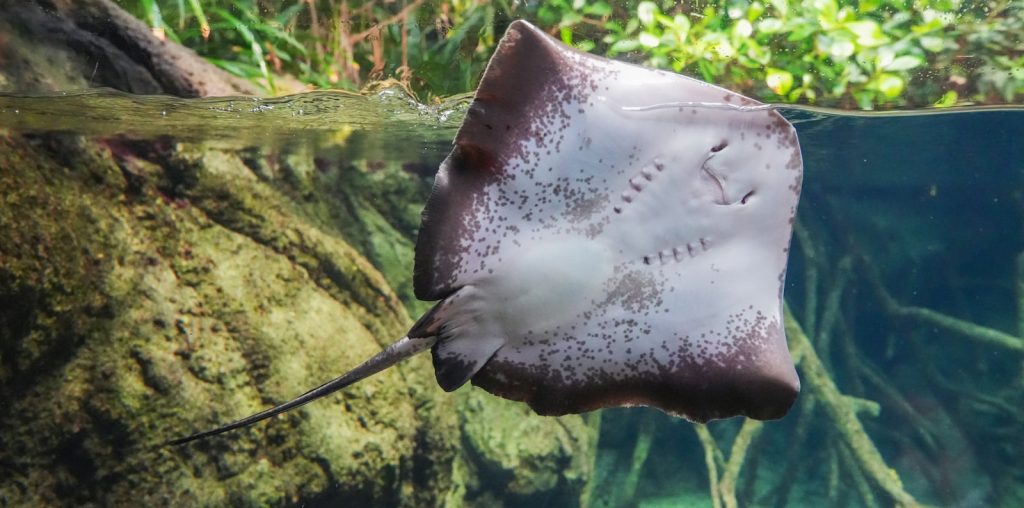
This is the prohibition with the most serious criminal exposure. Raja Ampat is widely cited as Indonesia's first shark and ray sanctuary, established under a Regent's declaration backed by national protected-species rules and Indonesia's CITES obligations. Every shark species present in these waters — reef sharks, wobbegong sharks, the distinctive walking sharks of genus Hemiscylliidae — and every ray species, including manta rays (Mobula alfredi and M. birostris), fall under protection.
The legal prohibition covers catching, hunting, injuring, killing, possessing, trading, and transporting any listed species or their parts. Fins and gill plates are explicitly included. An operator whose guests accidentally catch a shark on a fishing line faces a documentation and release obligation, not an opportunity for a trophy photograph. A fishing charter that knowingly targets sharks or rays is running criminal legal risk, not just permit risk.
This also touches tour design. Shark-feeding dives, where operators attract sharks to guests using bait, occupy a regulatory grey area in many destinations. In Raja Ampat's sanctuary framework, any practice that could be interpreted as capturing or restraining protected species — even temporarily for a photo — warrants explicit legal guidance before being added to a trip program.
Jet Skis and High-Speed Motorized Watercraft
Personal watercraft — jet skis, wave runners, and comparable high-speed motorized craft — are not permitted for recreational tourism use within MPA zones. The rationale combines reef and seagrass disturbance from wake wash, noise impact on marine fauna, and the elevated collision risk with divers and snorkelers. Some operators from more permissive Southeast Asian destinations assume jet skis are a routine amenity. They are not here, and marketing them as such constitutes a permit-level problem.
This matters for resort planning. Operators who have built a business model around water-sports packages need to understand that the activity portfolio in Raja Ampat is bounded by the sanctuary framework. Sea kayaking, stand-up paddleboarding, and non-motorized surface activity are generally unaffected. High-speed motorized water sports are not.
Building on Living Reef and Shoreline Setback Violations
Constructing any structure on living reef is effectively prohibited without high-level approval that, in practice, does not appear to be granted for commercial tourism development. The prohibition connects to the broader restrictions on habitat damage that apply MPA-wide: no extraction of coral, sand, or rock from the reef system; no mechanical disturbance of reef substrate during construction; no reclamation activities that bury or cover live coral.
Over-water bungalows and floating structures require specific zoning and structural approvals under the PBG (building permit, which replaced the former IMB system) and must be consistent with the provincial spatial planning instrument known as the RZWP3K (coastal and small-islands spatial plan). Exact construction setbacks and buffer specifications sit in provincial and regency spatial plans, not in documents that are readily public-facing in English. Any developer who proceeds without a current KKPR (spatial-use confirmation) and verified zoning compliance from the Raja Ampat Spatial Planning Office (Bappeda) is proceeding without ground truth.
The 2025 nickel-mining permit revocations — four IUPs cancelled following documented damage to islands within the UNESCO Global Geopark — demonstrated that even historically granted permits are not permanently secure when environmental impact becomes politically visible. For tourism developers, this is a signal, not just a mining-sector headline. Structures that create measurable reef or habitat damage are subject to the same political and legal vulnerability.
Dredging and Lagoon Alteration
Dredging to deepen access channels, improve boat approaches, or create artificial lagoons is prohibited within MPA zones absent rare, high-level environmental clearance. Even where dredging is technically outside a designated core zone, the AMDAL (environmental impact assessment) process for any project of meaningful scale will examine cumulative impacts on the MPA. An AMDAL that concludes negatively is not a technical setback — it is a legal barrier to the project proceeding.
This constraint is particularly relevant for marina and private-jetty proposals. The 2025 period saw jetty demolitions in addition to mining-permit revocations — physical enforcement of structural prohibitions, not just paper penalties. Operators who interpret "we have the lease" as "we can build what we want" are misreading the regulatory environment.
- Anchoring on live coral
- Prohibited MPA-wide; moorings or sand anchoring required; easily documented by enforcement.
- Spearfishing (tourist or staff)
- Prohibited within the MPA regardless of method (SCUBA or freediving).
- Catching or possessing sharks and rays
- Prohibited under sanctuary declaration and national protected-species law; covers all species + parts (fins, gill plates); criminal exposure.
- Jet skis and comparable motorized watercraft
- Not permitted for recreational tourism use within MPA zones.
- Building on living reef
- Effectively prohibited; over-water construction requires PBG + RZWP3K zoning compliance + KKPR.
- Dredging and lagoon reclamation
- Prohibited without rare high-level clearance; AMDAL required; jetty demolitions enforced in 2025.
- Destructive fishing methods
- Bomb fishing, poison fishing, and compressor (hookah) fishing banned across the MPA.
- Extraction of coral, sand, or rock
- Prohibited in core zones and subject to restriction across utilization zones.
Drone Restrictions
Drone regulations in Raja Ampat sit at the intersection of Indonesian national aviation rules and MPA-level management requirements. Indonesia requires drone operators to register their aircraft with the Directorate General of Civil Aviation (DGCA) and hold appropriate operator certification. Flying over protected areas without a permit from the relevant authority — in this context, the Marine Park Authority — is an additional layer of restriction.
In practical terms, operators who offer aerial photography as a guest experience or use drones for site-survey purposes need explicit written authorization from the Marine Park Authority before commercial drone operations begin. Repeat or high-altitude drone flights over nesting areas, marine mammal aggregations, or sensitive reef structures raise distinct concerns under conservation management guidelines. The authorization process is neither pro forma nor permanent — it is subject to renewal and can be withdrawn.
This matters commercially because drone footage has become a significant marketing asset for dive resorts and liveaboards. Resorts that rely on drone content produced on-site should verify their authorization status before building an entire visual identity around footage that may be legally problematic. The enforcement risk is not hypothetical — rangers with smartphones can document unauthorized drone operations in real time.
Fines, Enforcement, and Closure Risk
The enforcement architecture in Raja Ampat combines the Marine Park Authority's patrol capacity with Indonesian Police and Navy cooperation. This is not a single ranger on a small boat. Joint patrols cover the MPA systematically, and the growing international profile of the marine park — reinforced by the UNESCO Geopark status and the Gold Blue Park Award — creates an environment where documented violations attract not just local enforcement response but international conservation-community attention.
Indonesian fisheries and conservation law provides for:
- Criminal prosecution for violations of protected-species rules (sharks, rays, and listed fish species), including imprisonment and substantial fines.
- Vessel seizure for unauthorized or destructive fishing activities and for operating without required marine permits.
- Permit revocation for businesses found in systematic violation of MPA operating conditions — this applies to marine tourism permits, not just fisheries licenses.
- Forced closure of structures built in violation of zoning, building, or environmental permits — the 2025 jetty demolitions are the clearest recent example.
The financial exposure from a single enforcement action — seized vessel, legal defense costs, remediation obligations, reputational damage, permit re-application — routinely exceeds the short-term gain from the violation that triggered it. Operators in other Asian marine tourism destinations sometimes price enforcement risk as a manageable cost of doing business. That calculation does not apply in Raja Ampat's current regulatory and political environment.
It is also worth noting the guest dimension. Tourists who participate in prohibited activities — purchasing spearfished fish at a resort, photographing a restrained shark, riding a jet ski — can in principle face personal legal liability under Indonesian conservation law, in addition to the operator liability. A single viral incident can trigger enforcement action that grounds a business for weeks while permit status is reviewed.
If you are assessing a resort or liveaboard acquisition and want to understand the specific permit status and compliance history of the operation, plan your trip or investment review with our concierge. We connect investors with Indonesian legal counsel and local advisors who have direct experience with Marine Park Authority compliance requirements.
What Operators Can Do: The Permitted Framework
None of the above prohibitions exist in isolation from a clear permitted framework for sustainable commercial tourism. The Marine Park Authority collects an environmental service fee (LPJL) — IDR 700,000 per foreign visitor and IDR 425,000 per domestic visitor, valid for 12 months with multiple entries — specifically to fund conservation management and controlled tourism operations. That system exists because regulated tourism is the policy pathway the regency has chosen over extraction.
What operators can do, within permitted zones and with appropriate licensing:
- Lead guided SCUBA dives and snorkel tours at designated sites, including manta-ray encounters at Manta Sandy and Manta Ridge (observation only, no touching or riding).
- Operate liveaboard itineraries with proper mooring compliance and marine tourism operating permits.
- Conduct underwater photography and videography under the drone-authorization framework for aerial work.
- Run kayaking, stand-up paddleboarding, and non-motorized surface activities.
- Operate catch-and-release sport fishing in designated areas, subject to rules against targeting protected species.
- Host research, conservation-education, and citizen-science programs under research permit arrangements with the Marine Park Authority.
The permitted activity list rewards operators who design their businesses around low-impact, high-value encounters. The per-guest revenue model that makes Raja Ampat financially viable — where the 2023 visitor count of approximately 19,000 tourists generates revenue substantially exceeding what a mass-tourism model would produce at low margin — depends directly on conservation credibility. Operators who maintain that credibility, and who can document their compliance record, are also the operators with durable licensing relationships with the Marine Park Authority.
Practical Compliance Steps Before You Open
The prohibited-activities framework creates a clear compliance agenda for new operators. Before any business commences operations in the Raja Ampat MPA, the following steps are not optional:
Obtain the marine tourism operating license (izin usaha pariwisata bahari). This is issued through the risk-based OSS licensing system but requires prior confirmation that the business activity, its location, and its proposed operations are consistent with MPA zoning. The license does not waive or supersede MPA rules — it assumes compliance with them.
Complete AMDAL or UKL-UPL environmental review before any physical development. The threshold for full AMDAL vs the lighter UKL-UPL process depends on project scale and sensitivity — a 10-bungalow resort in a utilization zone may qualify for UKL-UPL; a larger development near core zones almost certainly requires full AMDAL. Get this assessment done by a licensed consultant before committing to site development budgets.
Establish mooring protocol and secure mooring permits where needed. This is the single most common operational compliance gap for new dive operators. The Marine Park Authority can confirm mooring status at specific sites; do this before including sites in your published itinerary.
Secure explicit drone authorization from the Marine Park Authority before any commercial drone operation, including for marketing content.
Train all staff and guides on the shark-and-ray sanctuary rules. The criminal exposure for possession of protected species applies to the business operator, not only to a guest who makes an unauthorized request. A staff member who catches and retains a shark at a guest's direction exposes the business to the same liability as if the operator had directed it.
Planning your compliance framework before signing a lease or acquiring a vessel is substantially cheaper than remediation after a violation. Our concierge team can connect you with on-the-ground legal and regulatory specialists — reach out via our contact page or WhatsApp to start a planning conversation, no obligation.
Frequently Asked Questions
Can a resort guest go catch-and-release fishing in Raja Ampat, or is all fishing banned?
All commercial and subsistence fishing by non-indigenous parties is prohibited or heavily restricted in core MPA zones. Regulated catch-and-release sport fishing is permitted in designated areas outside core zones, but the rules are site-specific and the operator is legally responsible for ensuring guests do not target protected species — sharks, rays, or any listed fish. Before advertising any fishing program, operators need explicit confirmation from the Marine Park Authority on which sites and methods are permitted, and that confirmation should be in writing.
What are the actual fines for anchoring on coral or other MPA violations?
Indonesian fisheries and conservation law sets criminal penalties rather than fixed administrative tariffs for serious violations. For destruction of coral reef or protected habitat, penalties can include imprisonment and fines at the level of criminal law, not regulatory infringement. Minor operational violations may result in warnings or permit conditions, but repeated or serious infractions — particularly those involving protected species or reef damage — expose operators to prosecution, not just a fine schedule. The more relevant financial exposure for most operators is permit revocation and the loss of the business's right to operate, which carries no fixed cap.
Are drone flights over the reef completely banned, or can operators get authorization?
Commercial drone operations for tourism purposes are not categorically banned, but they do require explicit authorization from the Marine Park Authority in addition to national DGCA registration and operator certification. That authorization is not automatic, is subject to conditions on flight zones and altitudes, and must be renewed. Operators who want to use drone footage for marketing or offer aerial photography as a guest experience should factor the authorization process into their pre-opening timeline — it is not an application that can be filed a week before launch.
Can I install a private jetty or boat dock at my resort site in the MPA?
Jetty and mooring structures require approval from both the Marine Park Authority and the relevant permitting authorities under the PBG (building permit) framework and coastal spatial planning rules (RZWP3K). The 2025 jetty demolitions in Raja Ampat — carried out as enforcement actions against structures built without proper authorization — are the relevant precedent here. A private jetty installed without complete permit coverage is not merely a regulatory irregularity; it is a structure that enforcement authorities have demonstrated they will require to be removed, at the operator's cost.
If I buy an existing resort that is already operating, am I inheriting any compliance risk?
Yes, potentially. Acquiring a going-concern resort through the purchase of a PT company (which is the typical transaction structure in Indonesia) means acquiring the entity that holds the permits — and any unresolved violations, conditions, or disputes attached to those permits transfer with the entity. Pre-acquisition due diligence should include a direct review of the resort's permit file with the Marine Park Authority, not just the seller's representations. Specific questions to ask: Has the permit ever been suspended or conditioned? Are there outstanding enforcement notices? Is the AMDAL current? What mooring arrangements are in place and are they documented? This is the kind of MPA-specific due diligence that generic legal guides do not cover, and it is worth engaging counsel with direct Raja Ampat regulatory experience before signing.