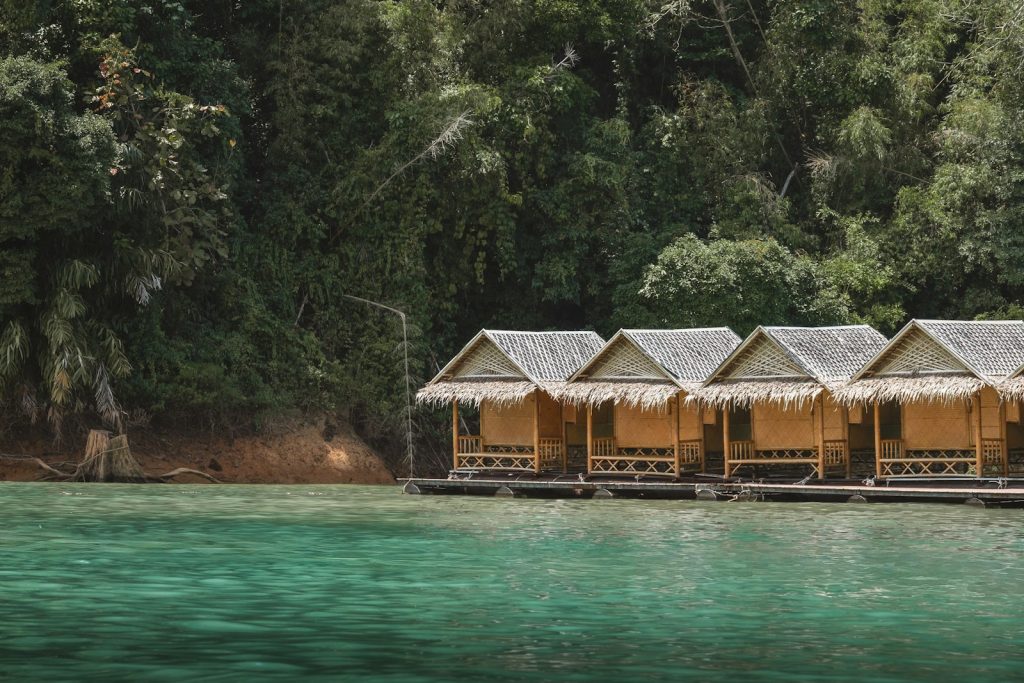
AMDAL and UKL-UPL are Indonesia’s two tiers of environmental assessment, and choosing the right one for an eco-resort in Raja Ampat is not a paperwork formality—it is the legal gate between a signed land agreement and a valid building permit. AMDAL (Analisis Mengenai Dampak Lingkungan) is a full environmental impact assessment required for large or high-risk projects; UKL-UPL (Upaya Pengelolaan Lingkungan Hidup–Upaya Pemantauan Lingkungan Hidup) is a lighter management-and-monitoring plan for projects below those thresholds. In Raja Ampat’s Marine Protected Area network, the normal national thresholds shift upward in significance: even a modest ten-bungalow resort can cross into AMDAL territory simply because of its location inside a protected zone, near a no-take zone boundary, or on a small island covered by Indonesia’s 2014 coastal law. Getting this wrong delays construction, voids other permits, and, in a regency where enforcement scrutiny has intensified since the 2025 mining-permit revocations, draws the kind of regulatory attention that can stall a project for years.
The National Threshold Framework—and Why Location Changes Everything
Under Indonesia’s risk-based licensing system introduced by PP 5/2021 and its implementing regulations, projects are assessed against a threshold table set by the Ministry of Environment and Forestry (KLHK). Projects that exceed any single threshold require a full AMDAL. Projects below all thresholds but still carrying measurable environmental risk require UKL-UPL. Projects with negligible impact file an even lighter SPPL (Surat Pernyataan Pengelolaan Lingkungan), essentially a self-declaration.
For coastal and marine tourism projects, the commonly cited triggers for AMDAL include:
- Land clearing or land reclamation above 5 hectares in a coastal or marine zone
- Total built area exceeding thresholds set per sector (hotel/resort projects above a certain floor area, typically in the range of 5,000–10,000 m² built area—confirm current figures in the KLHK threshold regulation, as these are periodically revised)
- Projects located within or adjacent to a kawasan lindung (protected area), which includes all seven of Raja Ampat’s designated MPAs
- Projects on small islands (pulau kecil), broadly defined as islands under 2,000 km², where the 2014 Law on Coastal Areas and Small Islands (UU 27/2007, amended by UU 1/2014) imposes additional constraints on new development
- Over-water structures including jetties, pontoons, and overwater bungalows, which directly interact with the marine environment
That last two points are where Raja Ampat diverges sharply from a comparable project on Bali’s southern coast. The regency is almost entirely composed of small islands. A ten-bungalow resort on Kri Island, on Misool, or anywhere in the Dampier Strait is simultaneously (a) within or adjacent to MPA zones, (b) on a small island under UU 1/2014, and (c) likely requiring a jetty or overwater structure. Any single one of those factors can push the project from UKL-UPL into AMDAL. All three together make AMDAL the near-certain requirement for most new eco-resort builds in the regency.
AMDAL vs UKL-UPL: The Practical Difference
Both instruments serve the same constitutional purpose—ensuring environmental protection before development proceeds—but they differ substantially in scope, cost, timeline, and the approving body.
| Feature | AMDAL | UKL-UPL |
|---|---|---|
| Full name | Analisis Mengenai Dampak Lingkungan | Upaya Pengelolaan & Pemantauan Lingkungan |
| Who triggers it | Projects above national thresholds OR in protected areas/small islands | Projects below AMDAL thresholds but with measurable environmental risk |
| Document set | KA-ANDAL (scoping) + ANDAL + RKL-RPL (management & monitoring plan) | Single UKL-UPL document (management + monitoring combined) |
| Public participation | Mandatory formal public consultation; community input is legally required | No formal public consultation required (though advisable in adat-land contexts) |
| Approving body | National KLHK for projects of national strategic significance; provincial DLHK for most tourism resorts; regency DLHK for smallest qualifying projects | Regency/city DLHK (Dinas Lingkungan Hidup) in most cases |
| Typical preparation cost (consultant) | IDR 300 million–800 million+ (USD 18,000–50,000+ range); highly project-specific | IDR 50 million–150 million (USD 3,000–10,000 range); simpler scope |
| Typical review timeline | 6–18 months, including scoping, assessment, expert panel, and approval | 1–4 months under normal processing |
| Output | SKKL (Surat Keputusan Kelayakan Lingkungan)—environmental feasibility decision | PKPLH (Persetujuan Kegiatan Pengelolaan Lingkungan Hidup)—approval letter |
| Required before | PBG (building approval) and all other substantive permits | PBG and all other substantive permits |
One practical note on the cost ranges: the figures above reflect what consultants in eastern Indonesia have charged for comparable projects, based on industry-wide reporting. They are not fixed tariffs. A Raja Ampat project adds logistical cost—the environmental consultant must survey the site (often requiring boat charters, dive surveys, coral assessment, and water-quality sampling over multiple trips from Sorong), and those field costs accumulate quickly.
Who Issues the Approval in Raja Ampat Specifically?
Jurisdiction depends on two variables: the scale of the project’s impact and whether the project touches national strategic interests.
For the majority of eco-resort developments in Raja Ampat—a facility of 8 to 20 bungalows, one dive center, one jetty, and supporting infrastructure—the approving body is the West Papua Provincial DLHK (Dinas Lingkungan Hidup) for AMDAL, or the Raja Ampat Regency DLHK for UKL-UPL. Projects that involve nationally strategic infrastructure, or that sit within a nationally designated conservation area under KLHK direct management, may require central KLHK approval or at minimum a coordination sign-off.
Raja Ampat’s MPAs operate under a UPTD BLUD (a semi-autonomous provincial technical unit with direct budget authority), which means the Marine Park Authority can and does require its own environmental compliance documentation in addition to, not instead of, the standard DLHK approval. Expect parallel processes, not a single queue.
The regency government (Dinas Pariwisata Raja Ampat) also requires a tourism business license (tanda daftar usaha pariwisata or TDUP under older terminology; now integrated into OSS risk-based licensing as izin usaha pariwisata), which cross-references the environmental approval. In practice, submitting for your tourism license before your AMDAL or UKL-UPL is complete will either stall the application or result in a conditional approval that cannot be exercised until the environmental document is finalized.
How the MPA Location Raises the Bar
Raja Ampat’s Marine Conservation Area spans approximately 13,550 km² of marine territory, organized into seven designated MPAs. The network includes strict no-take zones (zona inti) and tourism utilization zones (zona pemanfaatan). Most accessible resort locations sit in or adjacent to utilization zones, but the boundary between zones is not always obvious on the ground, and the spatial plans (RZWP3K and RTRW) that define them are not always publicly accessible in GIS-ready formats.
What this means for an AMDAL or UKL-UPL is that the environmental assessment must address:
- Coral reef baseline survey: A pre-project survey of reef health within the project’s area of influence, establishing a baseline against which future monitoring will be measured
- Marine mammal and protected species interaction: Raja Ampat is Indonesia’s first declared shark and ray sanctuary. The assessment must identify species present and model construction and operational disturbance pathways—boat noise, light pollution, sewage, solid waste
- Mangrove and seagrass assessment: Both habitats are present around most habitable islands and are subject to specific protection rules
- Waste management plan: Given no municipal waste infrastructure in the regency’s outer islands, the assessment must show a credible plan for organic waste, solid waste, grey water, and black water that does not discharge into the marine environment
- Construction-phase impact mitigation: How barge arrivals, land clearing, and building activity will be managed to avoid coral damage and sedimentation
An AMDAL in a non-protected area in Java or Bali will not include most of these. Raja Ampat’s version is substantively more demanding, which is one reason experienced local consultants emphasize budgeting for the field-survey component separately from the document preparation fee.
The regency’s UNESCO Global Geopark designation in 2023 and its Gold Blue Park Award in 2022 add an informal but real layer of international scrutiny. Geopark governance requires that member sites maintain conservation standards consistent with UNESCO expectations. A shoddy or incomplete AMDAL on a visible resort project creates political risk at a level well beyond a local permit dispute.
The AMDAL Process, Step by Step
Understanding the sequence matters because each step gates the next, and delays compound.
Step 1: Scoping (KA-ANDAL)
Before the full assessment begins, the developer submits a scoping document (Kerangka Acuan or KA-ANDAL) identifying the project boundary, activities, and the significant environmental impacts to be studied. The DLHK convenes a technical panel to approve the scope. This step alone can take 30–60 days under normal processing.
Step 2: Baseline Data Collection and Field Assessment
With the approved scope, the environmental consultant begins field work: reef surveys, water quality sampling, terrestrial ecological assessment, social-economic baseline for affected communities. In Raja Ampat, this phase routinely requires multiple site visits across seasons, given weather-driven access constraints. Budget for this phase to extend across the October-to-April dry season when boat access is more reliable.
Step 3: Impact Prediction and Mitigation Design (ANDAL)
The consultant prepares the formal ANDAL document—the technical impact analysis—alongside the RKL-RPL (management and monitoring plan). These two documents are submitted together as a package.
Step 4: Public Consultation
AMDAL requires a formal public hearing. In Raja Ampat this is not a box-ticking exercise: the affected community almost certainly includes adat clan members with customary rights over the land and adjacent marine area, and a superficial hearing that does not genuinely engage clan leadership can become grounds for later legal challenge. Experienced developers treat this stage as an extension of their adat negotiation, not a separate process.
Step 5: Technical Expert Panel Review
The DLHK convenes an expert panel (komisi penilai AMDAL) that reviews the documents, may request revisions, and ultimately issues a recommendation. Panel review can add 60–120 days.
Step 6: SKKL Issuance
If the panel is satisfied, the DLHK issues the SKKL—the formal environmental feasibility decision. This document is then cited in all downstream permits, including the PBG (building approval) and the tourism business license.
For investors currently evaluating sites, the practical implication is clear: allow a minimum of twelve months from project conception to SKKL for an AMDAL-required project in Raja Ampat, and budget a contingency for an additional six months. Timelines have stretched beyond two years for larger projects or those where the public consultation uncovered adat disputes requiring resolution before the process could continue.
If you are working through site selection and want to map the regulatory pathway before committing capital, the due-diligence conversation is worth having early. Start a planning conversation with our team—we can help frame the right questions to ask local legal counsel and the relevant government offices in Sorong and Waisai.
How Environmental Approval Gates Your Building Permit
Indonesia’s building permit system replaced the old IMB (Izin Mendirikan Bangunan) with the PBG (Persetujuan Bangunan Gedung) under the Job Creation Law and its implementing regulations. The PBG cannot be issued without prior KKPR (Kesesuaian Kegiatan Pemanfaatan Ruang)—spatial use confirmation—and without the AMDAL or UKL-UPL approval. The sequencing is not optional:
- KKPR (spatial use confirmation)
- Confirms the proposed activity is consistent with the spatial plan (RTRW) for the location. For a coastal or island resort in Raja Ampat, this requires alignment with the RZWP3K (regional coastal and small islands spatial plan) as well as the regency RTRW.
- AMDAL / UKL-UPL approval (SKKL or PKPLH)
- The environmental feasibility decision. Required before PBG can be processed.
- PBG (building approval)
- The technical building permit, issued by the regency government. Requires KKPR and environmental approval as prerequisites. Over-water and jetty structures typically require additional approvals from the port/harbor authority (KSOP Sorong) and, for structures within MPA zones, the Marine Park Authority.
- NIB (Nomor Induk Berusaha, via OSS)
- The business registration number issued through the national OSS system. Technically obtainable earlier in the process, but the tourism activity license attached to it cannot be activated until environmental and building permits are in order.
- Marine Park Authority operational permit
- For any commercial tourism activity within the MPA—including resort operation, dive services, and boat excursions—a separate permit from the Raja Ampat Marine Park Authority (UPTD BLUD) is required. This is renewed periodically and ties to compliance monitoring obligations.
A common mistake in project planning is to treat the environmental assessment as one item on a long parallel checklist. It is not parallel—it is sequential and foundational. Construction financed and started before SKKL issuance is illegal construction, regardless of whatever land agreement or preliminary approvals may be in hand. Enforcement in Raja Ampat has sharpened since 2025, when four nickel mining permits were publicly announced as revoked after Greenpeace documentation of environmental violations—a signal that conservation-compliance scrutiny is politically active at the highest levels of the provincial and national government.
Cost Ranges and Realistic Budgeting
The figures below are ranges drawn from industry-wide reporting on eastern Indonesian tourism projects, not quotes from specific consultants or fixed government tariffs. Treat them as order-of-magnitude guidance for financial modeling, and obtain specific quotes from licensed environmental consultants (konsultan AMDAL bersertifikat registered with KLHK) with Raja Ampat field experience.
| Item | UKL-UPL (approximate range) | AMDAL (approximate range) |
|---|---|---|
| Consultant preparation fee | IDR 50–150 million | IDR 300–800 million+ |
| Field surveys (reef, water, ecology) | IDR 20–50 million | IDR 75–250 million (multi-trip, multi-season) |
| Government review fees (PNBP) | Varies by regency; typically low (IDR 1–5 million) | Varies; confirm with West Papua DLHK |
| Public consultation logistics | Not required | IDR 10–30 million (venue, transport, documentation) |
| Translation / legal coordination | IDR 10–20 million | IDR 20–50 million |
| Typical total range | IDR 80–225 million (~USD 5,000–14,000) | IDR 400 million–1.1 billion+ (~USD 25,000–70,000+) |
| Typical timeline | 1–4 months | 9–18 months (Raja Ampat context; allow 24 months) |
These costs are real but manageable relative to total resort development capex—the issue is not cost but timeline. A project that underestimates the AMDAL timeline by twelve months runs out of working capital while waiting for the permit that unlocks everything else.
Practical Steps Before You Engage a Consultant
Three things an investor should verify before commissioning any environmental assessment work:
- KKPR first: Confirm the spatial-use compatibility of your intended site. If the RTRW or RZWP3K designates the area as a protected zone (kawasan lindung) or core MPA zone, no AMDAL will save the project—the activity is simply not permitted. This check costs nothing and can be done with a notaris or consultant before spending on environmental surveys.
- Adat consent as a prerequisite: The AMDAL public consultation will expose any unresolved adat or community-consent issues. Surfacing those issues in the consultation rather than resolving them beforehand adds months and uncertainty. Get the community agreement documented and signed before the environmental process begins.
- Check the consultant’s KLHK registration: Environmental consultants preparing AMDAL documents in Indonesia must hold a valid registration with the Ministry of Environment and Forestry. Confirm the registration is current and that the firm has completed projects in West Papua or the Bird’s Head region—familiarity with local MPA governance and the UPTD BLUD process is not interchangeable with mainland Indonesia experience.
If you are at the stage of selecting a site and want a structured read on the regulatory stack before committing—including which KKPR category applies, whether AMDAL or UKL-UPL is the likely threshold, and what the Marine Park Authority permit process looks like—reach out via our contact page or on WhatsApp. We connect investors with independent local legal counsel and licensed environmental consultants who know the Sorong and Waisai regulatory offices firsthand.
Frequently Asked Questions
If I build a small five-bungalow eco-camp, do I still need AMDAL in Raja Ampat?
Possibly, yes. The critical variable is location, not just size. If the site is within the MPA network, on a small island, or requires any over-water structure or new jetty, those factors can push even a small project into AMDAL territory regardless of bungalow count. A preliminary spatial check (KKPR) and a conversation with the West Papua DLHK or a licensed environmental consultant is the only reliable way to determine which instrument applies to your specific site.
Can I start construction while the AMDAL is still being processed?
No. Under Indonesian law, the environmental approval (SKKL for AMDAL; PKPLH for UKL-UPL) is a mandatory prerequisite for the PBG building permit. Beginning physical construction before the PBG is issued—or before the environmental approval that enables it—constitutes illegal construction. In Raja Ampat’s current regulatory climate, enforcement risk is real. Any construction already done without proper permits can be ordered demolished, and the resort license can be refused.
How long does the AMDAL process realistically take in Raja Ampat?
Budget for twelve to twenty-four months. The national regulatory timeline looks shorter on paper, but Raja Ampat adds complexity at multiple stages: logistical challenges for field surveys, the multi-step Marine Park Authority coordination, and the meaningful public consultation that adat-land contexts require. Projects that have tried to rush the process or skip genuine community engagement have faced either procedural delays or post-permit challenges that cost more time and money than the original process would have.
Who actually approves an AMDAL for an eco-resort in Raja Ampat—national, provincial, or regency government?
For a typical eco-resort (not a nationally strategic project), the approving body is the West Papua Provincial DLHK. The Raja Ampat Regency DLHK handles UKL-UPL approvals. The national KLHK is involved only for projects that meet national strategic impact thresholds or that sit within areas under direct central government conservation management. The Marine Park Authority (UPTD BLUD) runs a separate permitting track for operational tourism activities within the MPA and does not replace the DLHK environmental approval.
Does the environmental assessment cover the jetty and over-water bungalows separately?
No—the AMDAL or UKL-UPL covers the entire project as a single integrated activity, including all planned structures (jetty, bungalows, dive center, waste management facilities, access paths). However, over-water and jetty structures also require independent approvals from the harbor authority (KSOP Sorong) and, within MPA zones, specific Marine Park Authority permits for the structure’s location and design. The environmental assessment should explicitly address construction and operational impacts of all structures, because reviewers will flag any omission during the expert panel stage.