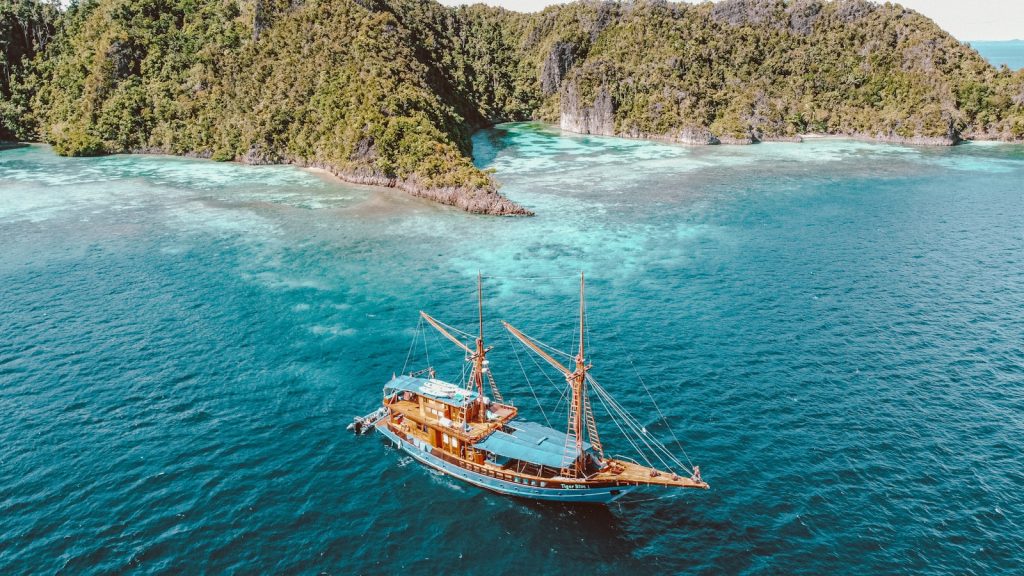
Buying versus building a phinisi for Raja Ampat is a capital allocation decision that most investor guides simply do not address: should you acquire an existing permitted vessel and begin operations relatively quickly, or commission a new build from a Sulawesi yard and wait 18 to 30 months for delivery? The answer is not universal — it depends on your timeline, your tolerance for construction-phase uncertainty, how much you trust a seller’s permit claims, and what you need from the asset on day one. This article maps what is verifiable about both paths, what each one actually costs in time and capital exposure, and which due-diligence questions matter most before you commit either way.
One preliminary point worth establishing: the phinisi itself is the asset in a liveaboard business, not the land. Unlike eco-resort investment in Raja Ampat — where adat clan tenure, unregistered coastlines, and competing customary claims create a layered risk profile before you pour a single foundation — a phinisi transaction sits almost entirely within Indonesian maritime law. That is a meaningful simplification. It is also not the same as saying the transaction is simple.
What a Phinisi Actually Is (and Why the Spec Matters Before You Price Anything)
A phinisi is a traditional two-masted wooden vessel from the Bugis shipbuilding tradition of South Sulawesi. In dive-tourism use, the modern phinisi is functionally a motor-sailer: diesel engines are the primary propulsion, the sails are raised occasionally or for aesthetic effect, and the hull is organized around guest cabins, a dive deck, a camera rinse station, a compressor room, and crew quarters. Hull lengths for operational liveaboards typically range from roughly 25 to 45 meters, with cabin counts anywhere from 4 to 16 guest berths plus crew.
The reason specifications matter before you price anything — buying or building — is that the gap between a 25-meter bare-bones wooden hull and a 40-meter, fully air-conditioned, 12-cabin dive vessel with a generator set, watermaker, satellite communications system, and dive-tender complement is not incremental. It is a completely different project. Published price ranges for phinisi vessels are nearly useless without a detailed specification attached, because two operators describing “a 30-meter phinisi” may be talking about assets that differ by USD 300,000 or more in true value.
Start your analysis with the specification — number of cabins, air-conditioning scope, engine and generator type, watermaker capacity, compressor type, tender arrangement, and safety equipment suite. Everything else flows from that.
The New Build Path: What It Involves and Where Costs Escape Control
New phinisi are built primarily in Bulukumba, South Sulawesi — the historical center of Bugis shipbuilding — with secondary capacity in East Kalimantan yards. Bulukumba has the deepest pool of skilled craftsmen and established relationships with hardware, timber, and ironwork suppliers. Construction quality varies between yards, and the informal nature of many workshop operations means that a site supervisor who visits regularly and understands both the local process and the finished-vessel specification is not optional — it is the difference between a vessel delivered on time and on budget versus one that arrives two years late and 40% over estimate.
Timeline: 18 to 30 Months Is Realistic, Not Pessimistic
A new dive-liveaboard phinisi built to full specification — cabins, electrical systems, dive deck configured, safety and navigation equipment installed — typically requires 18 to 30 months from contract signing to delivery in Sorong. The lower end applies to smaller, simpler vessels managed by experienced commissioning agents. Larger, more complex specifications and less attentive oversight tend to extend toward or beyond 30 months.
During that construction period the investor carries committed capital — deposits paid to the yard, materials purchased — without earning revenue. For a project with a 24-month build phase, that dead capital period is a real cost that should be modeled explicitly. At conservative opportunity cost rates, a multi-year period of capital committed but idle is a significant economic drag, separate from the construction contract value itself.
Where Costs Escape Control on a New Build
Material costs in Indonesia track global commodity prices for steel, hardwoods, and fuel. Since 2022, these have risen sharply. Investors who received yard quotes in 2021 and compared them to 2024 invoices found significant divergence. Any fixed-price contract with a Bulukumba yard requires careful legal drafting — most traditional yard operators are not sophisticated contract counterparties, and force majeure interpretations are loose.
The specific cost overrun patterns that experienced commissioning agents document repeatedly include: hull-framing timber substitutions (lower-grade wood substituted for contracted ironwood without notification), electrical system scope creep as the investor adds equipment mid-build, delayed import of specific components (engines, watermakers, electronics) that are not domestically manufactured, and yard-utilization conflicts where the master craftsmen are simultaneously working on other commissions. None of these are exotic risks — they are the standard experience reported by operators who have been through the process.
The practical implication: independent quantity surveying before signing the yard contract, and a qualified site supervisor with at least two prior phinisi commissions. The supervisor cost — typically a fixed monthly fee plus accommodation — should be budgeted from day one. It is a fraction of the construction contract and prevents multiples of its cost in overruns.
Permits on a New Build: You Start from Zero
A newly constructed vessel has no permits. Everything must be obtained fresh: the Surat Ukur (official measurement certificate from the Directorate General of Sea Transportation), the Grosse Akta (vessel deed from the Syahbandar / harbour master), the safety certification and seaworthiness certificate, the maritime operating license (SIUPAL or SIUPAR for nautical tourism), the NIB and downstream business licenses through OSS, and — critically — the commercial operating permit from the Raja Ampat Marine Park Authority (KKP UPTD BLUD). Each layer has its own timeline, issuing authority, and documentation requirement.
Starting from zero does mean you enter with a clean compliance history. There are no inherited defects, no lapsed renewals, no enforcement notes carried over from a previous operator. That is genuinely valuable. But it also means that the first guest cannot board until the full permit stack is in place, and the permit timeline begins only after the vessel is delivered and surveyable — it cannot run in parallel with construction in most practical cases. Budget a minimum of six to twelve months for permitting after delivery. Combine that with the construction phase and you are looking at a minimum 24 to 42 months from contract to first cruise.
The Acquisition Path: What You Are Actually Buying When You Buy a Permitted Phinisi
Buying an existing liveaboard in Raja Ampat sounds cleaner than a new build. In some cases it is. But “acquiring a vessel with permits included” contains at least six separate things that must be verified independently before you close, and conflating them into a single due-diligence step is how acquisition deals go wrong.
The Secondary Market Is Thin and Relationship-Driven
Operational liveaboards in eastern Indonesia do not trade on public platforms the way island-leasehold listings sometimes appear. The resale market is thin and largely relationship-driven — transactions happen through dive industry contacts, operator networks, distress sales following partnership disputes, or inheritance situations. This illiquidity is a structural feature of the asset class, not a temporary market condition. It has two implications: finding the right acquisition takes time and local network access, and at exit you will face the same thin buyer pool you are navigating as a buyer today.
The practical consequence for pricing is that there is no public comparable-sales database to benchmark against. Valuations are negotiated, not discovered through market depth. An independent marine surveyor and a licensed Indonesian maritime lawyer are the closest substitutes for market transparency. Using either a general PT PMA consultant without maritime specialization, or taking a seller’s valuation at face value, is a meaningful risk.
Six Things Bundled Into “Permits Included” — Verify Each Separately
When a seller describes a phinisi as having “all permits” or “Raja Ampat permits included,” that phrase is doing a great deal of work. What it typically refers to — and what each element actually requires to verify — breaks down as follows:
- Vessel registration and Indonesian flag status
- Confirm the current Grosse Akta (vessel ownership deed) shows the selling entity as owner, and that the vessel is properly registered under the Indonesian flag with the Directorate General of Sea Transportation. Check that the registration is current and that no liens, mortgages, or encumbrances are registered against the vessel. A maritime lawyer should conduct this title search directly with the Syahbandar registry — do not rely on the seller’s copy of the document alone.
- Maritime safety and seaworthiness certification
- The vessel must hold a current safety certificate and pass a Syahbandar inspection confirming seaworthiness. These certificates expire on fixed cycles. A vessel with lapsed safety certification cannot legally carry commercial passengers. Verify the expiry date on the current certificate and build the renewal cost and timeline into your first-year budget.
- Maritime operating license (SIUPAL / SIUPAR)
- The national maritime tourism operating license is issued to the legal entity (the PT or PT PMA), not to the vessel itself. If the seller’s PT holds this license, you need to understand whether you are buying the vessel alone (requiring a fresh license application) or acquiring the entire operating entity including its PT. These are very different transactions with very different implications for tax, liability, and timeline.
- Marine Park Authority operating permit
- The commercial dive-operating permit from the Raja Ampat KKP UPTD BLUD is the permit that matters most on a day-to-day operational basis inside the MPA. This permit is issued to the operator and may be tied to the vessel or to the entity. Verify directly with the Waisai park authority office that the permit is current, that it covers the claimed operational zones, and whether it is transferable to a new owner or requires reapplication. Do not accept the seller’s assurance — call or visit the authority directly.
- Per-guest MPA entry tag compliance
- The marine park entry tag (IDR 700,000 per foreign visitor, IDR 425,000 domestic, 12-month validity) is administered through the BLUD’s online system. Verify that the selling operator has no outstanding compliance arrears — unpaid tag fees or enforcement notices that could attach to the operating relationship rather than to the entity alone.
- NIB and downstream business licenses in OSS
- The selling entity’s NIB (business identification number) and any OSS-issued business licenses should be checked for currency. Under PP 5/2021’s risk-based licensing framework, licenses that lapse may require full reapplication. If you are acquiring the PT entity, inherited compliance obligations — including LKPM quarterly investment reporting and tax filings — transfer with it.
A claim that “permits are included” is only as valuable as the specific verification of each one of these six layers. Sellers who resist this level of scrutiny are providing useful information about why the deal is structured the way it is.
Comparing the Two Paths: A Structured View
| Factor | New Build (Commission) | Acquisition (Buy Existing) |
|---|---|---|
| Time to first cruise | 24–42 months (build + permits from zero) | 6–18 months (due diligence + permit transfer verification + any registration changes) |
| Specification control | Full — you design to your standard | None — you accept the existing vessel as-is, with modification costs added |
| Permit status at entry | None; must obtain full stack post-delivery | Claimed permits exist; must verify each layer independently |
| Cost predictability | Low — overruns are the standard experience | Moderate — survey reveals condition; hidden defects remain a risk |
| Compliance history | Clean slate — no inherited defects | Inherited — may include lapsed certs, enforcement notes, tax arrears |
| Market liquidity for resale | Thin — same market at exit | Thin — same market at exit |
| Capital at risk before revenue | High — 24–42 months of committed capital earning nothing | Lower — operational faster once diligence clears |
| PT/entity structure complexity | Build entity first, then register vessel to it | Option to acquire the entire PT (with obligations) or vessel only |
| Physical condition uncertainty | None — condition known from day of launch | Real — survey required; wooden vessels can carry hidden structural defects |
| Construction phase risk | Significant — yard fires, master craftsman disputes, material substitution | None |
The Permit Transfer Question: How It Actually Works in Practice
The phrase “permit transfer” suggests a clean handover. The reality in Indonesian maritime administration is messier. The key distinction is between permits held by the vessel and permits held by the legal entity operating it.
Vessel-specific documents — the Grosse Akta, the Surat Ukur, safety certificates — follow the vessel as long as ownership is properly updated at the Syahbandar. These are manageable to transfer if the documentation is in order and the selling entity has no registration problems.
Operating licenses issued through OSS — the SIUPAR, the NIB, the downstream tourism and transport licenses — are issued to the legal entity. They do not automatically transfer when a vessel changes hands. If you are buying the vessel from a PT but not acquiring the PT itself, those licenses stay with the selling entity. You need to apply for your own. If you are acquiring the PT entity, you inherit both the licenses and every obligation and liability the PT carries — tax arrears, LKPM filing gaps, any regulatory notices. Neither path is cost-free or quick.
The Marine Park Authority permit is particularly important to verify on transfer. The UPTD BLUD in Waisai issues these against specific operators and operational conditions. Whether a permit attached to a seller’s operating entity can be extended to a buyer’s entity — or whether it requires reapplication, including a new assessment of the buyer’s compliance capability — is a question that must be answered directly with the authority, not assumed from past precedent or broker assurance.
Insurance, Safety Standards, and Why the International Booking Market Cares
This section is not about compliance theater. It is about what determines whether international guests actually book your boat.
The dominant international dive-travel booking platforms — and the agent networks that move high-value international guests — apply their own vetting standards. A vessel without current P&I (protection and indemnity) insurance, without certified safety equipment (life rafts, EPIRBs, fire suppression), without crew holding valid STCW (Standards of Training, Certification and Watchkeeping for Seafarers) certifications, and without a dive operation that aligns with recognized safety standards will not be listed on the major platforms. Full stop.
When you are evaluating an acquisition, ask for the insurance certificates — not summaries, the actual policies — and check expiry dates and coverage scope. Ask for STCW certificates for the captain and engineer. Review the safety equipment inventory against Indonesian maritime safety regulations and against the requirements of the platforms you intend to sell through. A vessel priced attractively because the current operator has been running informally or under-insured is an asset with a compliance remediation cost embedded in the discount. That cost needs to be modeled before you conclude the price is attractive.
On a new build, you have the advantage of specifying safety equipment from the outset and selecting crew whose certifications meet international standards from day one. The cost is higher upfront; the remediation-later scenario is avoided.
The Operating Entity Question: PT PMA, National PT, or Indonesian Partner?
Indonesia’s cabotage principle requires that commercial domestic passenger transport — which a liveaboard operating between Raja Ampat islands clearly is — be conducted by Indonesian-flagged vessels under Indonesian-incorporated entities. A foreign individual cannot legally own and commercially operate a phinisi in Indonesian waters without an Indonesian legal entity structure.
For a foreign investor, the standard path is a PT PMA (foreign-invested limited company). Under the current Positive Investment List (Perpres 10/2021 as amended by Perpres 49/2021), large-scale maritime tourism is generally open to 100% foreign ownership through a qualifying PT PMA. The qualifying threshold places the entity in the large-enterprise category — an investment plan exceeding IDR 10 billion (excluding land and buildings) per business field per project location, under PP 7/2021.
Minimum paid-up capital has been cited by advisors at IDR 2.5 billion (approximately USD 150,000 at mid-2026 rates) following a 2025 reduction — though advisors report inconsistent figures and the applicable BKPM regulation should be confirmed at the time of application. Corporate income tax applies at 22%; dividend withholding tax at 20%, reducible under applicable bilateral tax treaties.
The correct KBLI codes for a liveaboard operation span multiple categories: sea passenger and charter transport (approximately KBLI 50119), marine recreation and dive tourism (93119 or 93299), and possibly tour operations (79122) depending on how the business revenue is structured. Selecting the wrong KBLI at OSS registration creates downstream licensing problems — the licenses that follow from the NIB depend on the business field codes selected. This is a practical reason to retain a business-setup consultant with specific maritime tourism experience, not a standard PT PMA incorporation service.
The alternative — partnering with an Indonesian national through a national PT structure — eliminates the PT PMA capital threshold and simplifies some registration steps. It introduces partner-dependency risk that deserves its own due diligence process. Indonesia’s 2007 investment law prohibits nominee arrangements; a structure that places a nominal Indonesian shareholder on the register while the foreign investor holds the economic interest is illegal and subject to forfeiture. Any partnership with an Indonesian national should reflect a genuine operational or capital contribution and be documented by an Indonesian notaris with relevant experience.
Realistic Timeline from Decision to First Cruise
One figure that rarely appears in phinisi sales pitches or build proposals is an honest, integrated timeline that includes entity setup, vessel delivery or due diligence, permit applications, and a buffer for the bureaucratic delays that are routine in eastern Indonesia. The table below presents a realistic minimum-case view for each path.
| Stage | New Build | Acquisition |
|---|---|---|
| PT PMA / entity setup | 4–8 weeks (can run parallel with build contract) | 4–8 weeks (can run parallel with due diligence) |
| Vessel construction (new build) / due diligence and negotiation (acquisition) | 18–30 months | 2–6 months |
| Maritime registration, vessel survey, flag registration | 2–4 months (post-delivery) | 1–3 months (ownership transfer) |
| National operating license (SIUPAR) and OSS licensing | 2–4 months | 1–3 months (new application) or inherited with PT acquisition |
| Marine Park Authority operating permit | 2–4 months (first-time applicant) | 1–4 months (transfer or new application — verify with authority) |
| Total minimum to first cruise | Approximately 24–42 months | Approximately 6–18 months |
The acquisition range of 6–18 months has a wide band because the lower end assumes clean permits, a willing seller with documented compliance, and a straightforward PT share transfer — a set of conditions that is possible but should be proven, not assumed. The higher end reflects the more common experience of permit reapplication, vessel condition remediation, or entity restructuring discovered during diligence.
The “Permits Included” Claim: A Due-Diligence Framing for Every Meeting with a Seller
Sellers of operational liveaboards routinely describe the asset as including valid permits. Some of those claims are accurate. Some reflect permits that are current in name but lapsed in practice — certificates not renewed, fees unpaid, conditions not met. Some reflect permits held by the selling entity that will not automatically transfer with the vessel.
The framing that works in practice is not “are the permits included?” but rather a specific document request list handed to the seller at the first substantive meeting. Request: the current Grosse Akta with Syahbandar certification, the Surat Ukur, all safety certificates with expiry dates, the SIUPAR with NIB number, the Marine Park Authority permit with its issue and expiry dates, P&I insurance policy, and any correspondence with regulatory authorities in the past 36 months. A seller who cannot produce all of these within two weeks of a serious buyer’s request is telling you something about how the operation has been managed.
Separately, verify the Marine Park Authority permit directly with the Waisai office. This is not a distrust-of-sellers issue — it is recognizing that paper documents do not always reflect current administrative status, especially for permits that require annual renewal or reporting compliance. The park authority’s operating permit is the one document in the stack that most directly determines whether you can legally operate in the water you are buying into.
Conservation Obligations That Apply Regardless of Which Path You Choose
Whether you build new or acquire an existing vessel, the conservation operating framework inside the Raja Ampat MPA network is identical. Several obligations deserve specific mention because they have real cost and operational implications.
No anchoring on live coral is an absolute rule, enforced by the park authority and increasingly monitored. The MPA network covers approximately 13,550 km² of marine area, and established mooring buoys exist at the highest-traffic dive sites in the Dampier Strait, around Misool, and at Wayag-area locations. At sites without moorings, anchoring is restricted to sand or rubble. Route planning and itinerary design must build this in — a 40-meter phinisi cannot simply drop hook wherever the guide wants to dive.
The shark and ray sanctuary — widely described as Indonesia’s first — covers all shark and ray species: reef sharks, wobbegongs, the endemic walking sharks, oceanic and reef manta rays. Commercial operation imposes a specific obligation to brief guests, train dive guides on the protocol, and ensure no crew conducts any fishing that could entangle or harm protected species. This is a compliance cost, but it is also one of the primary marketing assets of operating in Raja Ampat: guests pay a premium specifically to encounter these animals under sanctuary conditions.
Every foreign visitor aboard a vessel inside the MPA must carry a valid marine park entry tag — currently IDR 700,000 per foreign person, IDR 425,000 domestic, valid 12 months across multiple entries. On a 16-guest liveaboard with predominantly foreign guests, this is a real per-cruise cost line item that should appear in your financial model, even if the operator passes it through in the guest’s package price.
The 2025 revocation of four nickel mining permits in Raja Ampat — covering PT Kawei Sejahtera Mining on Kawe Island, PT Anugerah Surya Pratama on Manuran, PT Mulia Raymond Perkasa on Manyaifun and Batang Pele, and PT Nurham on Waigeo — is relevant background for tourism investors. The revocations were announced following Greenpeace Indonesia’s documentation of environmental damage within the UNESCO Global Geopark boundary (designated 2023), and subsequent public pressure. Later investigations by Earth Insight and Wallacea found no published revocation decrees, leaving legal finality uncertain. The one mining operation not revoked — PT Gag Nikel on Gag Island, part-owned by state miner Antam — lies outside the geopark boundary and reportedly resumed operations around September 2025. The signal for conservation-aligned tourism operators is that the political and social momentum in Raja Ampat runs strongly against high-impact extraction and toward the kind of low-footprint marine tourism a well-run liveaboard represents. That alignment does not eliminate regulatory risk — it shapes where that risk is highest.
Frequently Asked Questions
How long does it realistically take to get a new phinisi built and into commercial operation in Raja Ampat?
The honest range is 24 to 42 months from signing a build contract to completing the first commercial cruise. Construction in Bulukumba or comparable Sulawesi yards takes 18 to 30 months for a fully specified dive-liveaboard vessel. After delivery, maritime survey and flag registration, national operating license (SIUPAR) through OSS, and the Marine Park Authority operating permit each add time — with a realistic minimum of six to twelve additional months for a first-time applicant working through all layers without prior relationships in the Sorong or Waisai offices. Budget for delays at every stage.
When a seller says a phinisi has “Raja Ampat permits included,” what specific documents should I request?
Request these seven documents in their original or notarized form, each with its expiry date visible: the current Grosse Akta (vessel ownership deed) with Syahbandar certification showing no encumbrances; the Surat Ukur (measurement certificate) from the Directorate General of Sea Transportation; current safety and seaworthiness certificates; the SIUPAR (nautical tourism operating license) with NIB number; the Marine Park Authority (KKP UPTD BLUD) commercial operating permit; a current P&I insurance certificate with policy terms; and any regulatory correspondence from the past 36 months. Then verify the Marine Park Authority permit directly with the Waisai office — document status on paper does not always match current administrative standing.
Can I buy a phinisi and its permits as a package without acquiring the seller’s PT company?
The vessel documents — Grosse Akta, Surat Ukur, safety certificates — can in principle be transferred to a new owning entity. Operating licenses issued through OSS (the SIUPAR, NIB, tourism licenses) are held by the legal entity, not the vessel, and do not automatically follow a vessel sale. If you buy the vessel without the PT, you will need to apply for your own operating licenses, which adds three to six months minimum. Acquiring the PT itself transfers both the licenses and every obligation the entity carries — including any tax arrears, lapsed filings, or regulatory matters. Neither option is cost-free; each requires a specific due-diligence scope. A licensed Indonesian maritime lawyer should advise on the mechanics before any heads-of-terms are signed.
What are the biggest cost overrun risks on a new phinisi build versus an acquisition?
On a new build, the main overrun categories are: timber substitution by the yard (lower-grade wood than contracted), mid-build specification additions by the investor (almost universal), component import delays for engines and electronics, and construction timeline extensions that extend the dead-capital period. On an acquisition, the hidden cost categories are: vessel condition remediation discovered in survey (wooden vessels can hide rot, hull deformation, and electrical problems that a non-specialist survey misses), permit reapplication costs where claimed permits are lapsed or non-transferable, and PT entity cleanup costs where inherited compliance obligations — tax arrears, LKPM filing gaps — surface after closing. In both cases, the investor who engages independent professionals before committing — a quantity surveyor on builds, a marine surveyor plus maritime lawyer on acquisitions — avoids the large majority of these surprises.
Does a new build avoid all the permit complications of an acquisition?
It avoids the inherited-compliance risk. But it replaces it with the challenge of building a complete permit stack from scratch — vessel registration, seaworthiness certification, national operating license, and Marine Park Authority permit — for an entity and vessel that have no operating history in the system. First-time applicants typically take longer through each layer than experienced operators with existing relationships. The clean-slate advantage is real; so is the relationship-building cost. Factor in both when comparing paths.